
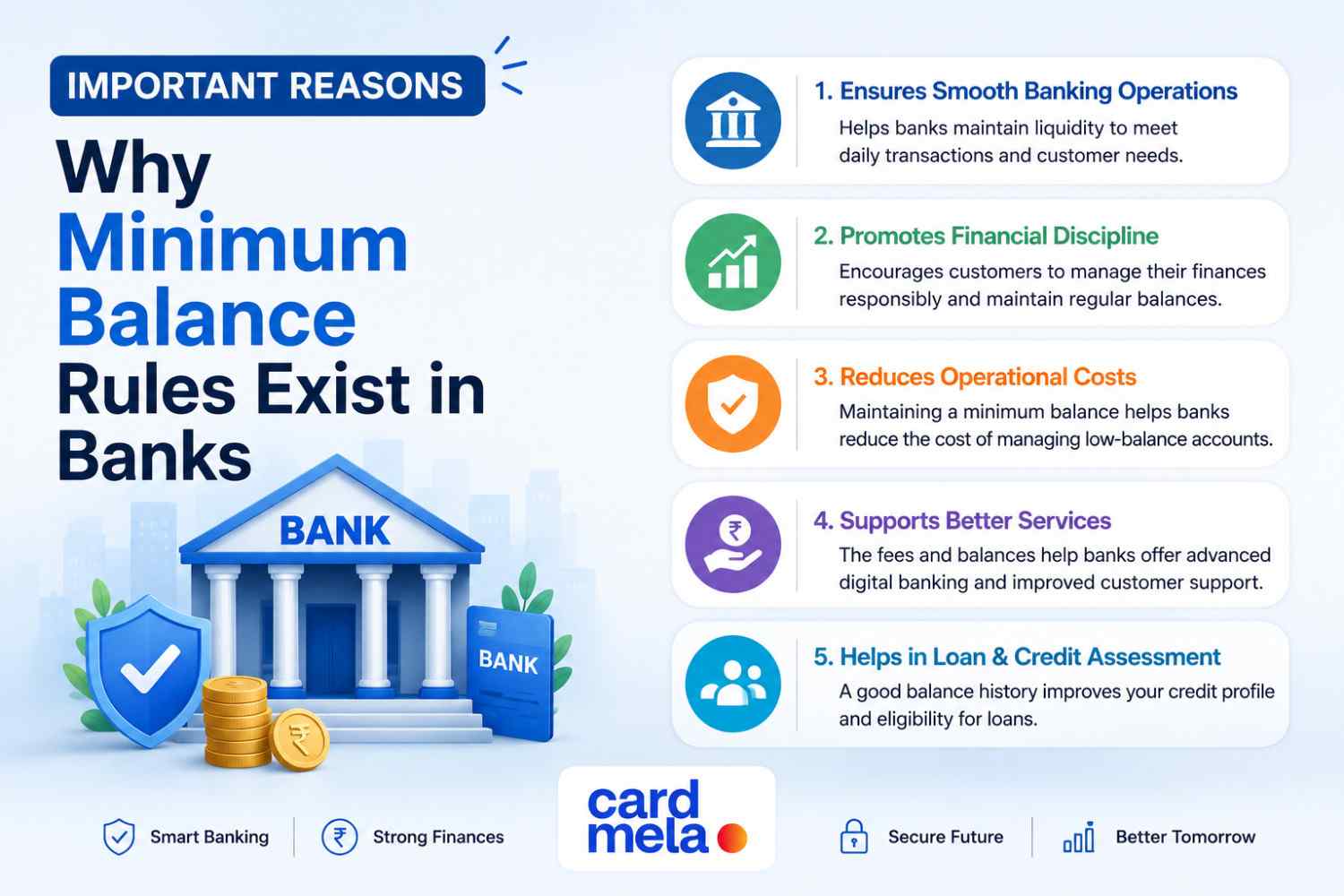
7 Important Reasons Why Minimum Balance Rules Exist in Banks
Table of Contents
7 Important Reasons Why Minimum Balance Rules Exist in Banks
Introduction
Minimum balance rules are among the most discussed banking policies in India. Millions of customers regularly question why banks require account holders to maintain a fixed balance in their savings accounts and why penalties are charged when balances fall below prescribed limits.
In 2026, as India’s banking system becomes increasingly digital and transaction-heavy, minimum balance policies continue to play a significant role in maintaining financial stability, operational efficiency, and service sustainability for banks.
Whether customers bank with HDFC Bank, ICICI Bank, State Bank of India, or Axis Bank, most traditional savings accounts still include some form of Average Monthly Balance (AMB) requirement.
Many consumers assume banks impose minimum balance rules simply to earn penalty income. However, the reality is more complex. These policies help banks manage operational costs, liquidity requirements, infrastructure investments, customer servicing expenses, and digital banking ecosystems.
India’s modern banking infrastructure now supports:
- UPI transactions
- Mobile banking
- ATM networks
- Instant fund transfers
- AI-driven banking systems
- Credit card integrations
- Online customer support
- Fraud monitoring systems
Maintaining these services requires enormous financial and technological investment.
Banks regulated by the Reserve Bank of India use minimum balance systems as part of broader banking economics and risk management structures.
Understanding why these rules exist can help consumers manage their accounts more intelligently while avoiding unnecessary penalties and improving overall financial planning.
What Is Minimum Balance in Banking?
Minimum balance refers to the amount a customer must maintain in a bank account to avoid penalty charges.
Banks may calculate this requirement in different ways:
- Average Monthly Balance (AMB)
- Minimum Daily Balance
- Quarterly balance requirement
- Product-specific balance conditions
The required amount often depends on:
- Account type
- Urban or rural branch category
- Banking relationship level
- Premium service eligibility
Premium accounts usually require higher balances because they provide additional features and banking privileges.
Table: Common Types of Minimum Balance Systems
| Type | Explanation |
|---|---|
| Average Monthly Balance | Monthly average maintained |
| Daily Minimum Balance | Fixed daily amount required |
| Quarterly Balance | Quarterly average requirement |
| Zero Balance Account | No balance requirement |
Table: Why Banks Use Minimum Balance Policies
| Reason | Banking Benefit |
|---|---|
| Operational cost recovery | Financial sustainability |
| Liquidity management | Better stability |
| Infrastructure funding | Improved services |
| Customer segmentation | Premium banking efficiency |
Important Reasons Why Minimum Balance Rules Exist
One of the primary reasons banks impose minimum balance rules is operational cost management.
Every bank account generates expenses for the bank including:
- ATM access
- Debit card issuance
- Mobile banking support
- SMS alerts
- Customer care services
- Fraud protection systems
- Server infrastructure
- Branch operations
Banks need stable deposits to offset these costs and maintain profitability.
Minimum balance systems also help banks maintain liquidity. Deposits allow banks to provide loans, support lending operations, and maintain regulatory reserve requirements.
Another major reason is customer segmentation. Premium banking services such as relationship managers, lounge access, wealth advisory, and enhanced transaction limits are often linked with higher balance accounts.
Banks additionally use minimum balance rules to encourage long-term customer engagement and stable deposit relationships.
Benefits of Minimum Balance Policies
Although many customers dislike minimum balance requirements, these systems also provide indirect benefits to banking ecosystems.
Stable deposits help banks strengthen lending capacity and improve overall financial stability.
Maintaining healthy account balances often gives customers access to premium services, lower fees, better transaction limits, and exclusive banking privileges.
Banks with stronger deposit bases can additionally invest more aggressively in digital infrastructure, cybersecurity, AI systems, and customer support improvements.
Minimum balance structures also encourage financial discipline because customers become more aware of budgeting and account management practices.
For long-term banking relationships, maintaining strong balances may improve eligibility for loans, premium cards, and wealth management services.
Best Credit Cards Linked with Premium Banking Benefits
HDFC Bank Regalia Gold Credit Card
Regalia Gold offers travel rewards, airport lounge access, lifestyle benefits, and premium banking integration for high-value users.
Axis Bank Atlas Credit Card
Axis Atlas is increasingly popular among professionals seeking travel optimization and strong reward systems linked with premium banking experiences.
ICICI Bank Emeralde Credit Card
ICICI Emeralde targets affluent users with premium privileges, concierge services, and luxury-focused banking experiences.
YES Bank Marquee Credit Card
YES Bank Marquee combines travel, entertainment, shopping, and premium digital banking features.
AU Zenith+ Credit Card
AU Zenith+ is gaining attention for premium rewards, lifestyle privileges, and modern banking integrations.
IDFC FIRST Wealth Credit Card
IDFC FIRST Wealth focuses on premium customers seeking reward optimization and wealth-management-style banking relationships.
Table: Best Premium Credit Cards for Banking Customers
| User Type | Recommended Card |
|---|---|
| Travel users | Axis Atlas |
| Luxury lifestyle | ICICI Emeralde |
| Banking relationship users | Regalia Gold |
| Rewards optimization | YES Marquee |
| Wealth-focused users | IDFC FIRST Wealth |
Table: Savings Accounts vs Premium Banking Accounts
| Feature | Regular Savings Account | Premium Banking Account |
|---|---|---|
| Minimum balance | Lower | Higher |
| Lounge access | Rare | Common |
| Dedicated support | Limited | Yes |
| Wealth services | Basic | Advanced |
Explanation
India’s banking sector has changed dramatically with digital transformation.
Modern banks operate massive technology ecosystems supporting millions of transactions daily across:
- UPI systems
- Mobile apps
- ATM networks
- Credit cards
- AI fraud detection
- Online banking portals
- International payment systems
Maintaining this infrastructure requires substantial investment.
Banks therefore rely heavily on stable customer deposits as a low-cost funding source.
Minimum balance policies help banks maintain predictable liquidity and operational efficiency while supporting large-scale digital banking ecosystems.
Without stable deposits, banks would struggle to provide low-cost banking services at current scale and speed.
Uses of Minimum Balance Systems
Minimum balance systems serve several strategic purposes within banking operations.
Banks use deposits to:
- Fund lending operations
- Improve liquidity management
- Support branch expansion
- Maintain digital infrastructure
- Strengthen reserve requirements
- Manage operational costs
- Improve financial stability
Customers with stable balances additionally gain access to better financial products including loans, premium banking programs, and high-value credit cards.
Banks also analyze account balance behavior while evaluating financial credibility and relationship value.
Tips to Avoid Minimum Balance Penalties
Consumers should first understand the exact balance requirements associated with their account type because rules vary significantly between banks and cities.
Users maintaining low balances should consider switching to zero-balance accounts whenever possible.
Mobile banking alerts and balance notifications can help customers avoid accidental penalties.
Consumers should additionally maintain emergency buffers instead of keeping accounts close to minimum thresholds.
Salary accounts sometimes automatically convert into regular savings accounts after employment changes, leading to unexpected balance penalties if not monitored properly.
Users should periodically review account charges and compare banking products to identify more suitable options.
Table: Smart Banking Tips
| Strategy | Benefit |
|---|---|
| Use balance alerts | Avoid penalties |
| Maintain emergency buffer | Better stability |
| Review account type | Lower charges |
| Monitor SMS notifications | Improved awareness |
Table: Common Minimum Balance Mistakes
| Mistake | Financial Impact |
|---|---|
| Ignoring AMB rules | Penalty charges |
| Maintaining low balances | Repeated fees |
| Not checking account conversion | Unexpected deductions |
| Multiple inactive accounts | Unnecessary charges |
How Digital Banking Is Changing Minimum Balance Policies
Digital banking and fintech innovation are slowly transforming traditional balance requirements.
Several neo-banks and fintech platforms now offer:
- Zero balance accounts
- Digital-only banking
- App-based savings systems
- Lower operational costs
- AI-driven customer service
However, traditional banks still rely heavily on deposit stability for large-scale operations.
Organizations like National Payments Corporation of India continue expanding digital payment ecosystems, increasing transaction volumes significantly across India.
As competition grows, banks are expected to redesign account structures and create more flexible balance systems for digitally active users.
Table: Future Trends in Banking Policies
| Trend | Expected Impact |
|---|---|
| Digital-only accounts | Lower balance requirements |
| AI-based banking | Better personalization |
| Neo-bank competition | Reduced penalties |
| App-driven banking | Higher efficiency |
Internal Linking
- Best Zero Balance Savings Accounts in India
- Best Cashback Credit Cards in India
- Credit Cards That Work Best with Google Pay & PhonePe
- Smart Ways to Improve Your Credit Score
- Best Premium Credit Cards in India
- Digital Banking Trends in India 2026
External Linking
Conclusion
Minimum balance rules remain an important component of India’s banking system because they help banks maintain operational stability, support lending capacity, and sustain large-scale digital infrastructure investments.
While customers often view these policies negatively, they play a significant role in maintaining efficient banking ecosystems capable of supporting millions of digital transactions daily.
At the same time, growing fintech competition and digital banking innovation are pushing banks toward more flexible account structures and customer-friendly policies.
Consumers who understand account rules carefully, maintain financial discipline, and choose suitable banking products can avoid unnecessary penalties while maximizing banking benefits effectively.
India’s banking sector will likely continue evolving toward increasingly digital, AI-driven, and customer-personalized financial ecosystems in the coming years.
FAQs (Frequently Asked Questions)
Should students and young professionals worry about minimum balance penalties?
Yes. Many students and young earners unknowingly open regular savings accounts without understanding balance requirements properly. Since income flow may remain inconsistent during early career stages, repeated penalties can quietly reduce savings over time. Choosing student-friendly or zero-balance accounts is often more suitable for beginners.
Why do salary accounts sometimes start charging penalties later?
Salary accounts usually remain zero-balance while salary credits continue regularly. However, if salary deposits stop because of job changes or employer switching, banks may automatically convert the account into a regular savings account with standard balance requirements. Customers who fail to notice this change often face unexpected deductions.
Can minimum balance penalties affect credit scores?
Directly, no. Savings account penalties generally do not affect credit scores. However, if penalties cause cheque bounces, unpaid EMIs, or insufficient funds for loan repayments, indirect financial consequences may eventually impact creditworthiness.
Do public sector banks and private banks have different balance policies?
Yes. Public sector banks often maintain lower balance requirements compared to premium-focused private banks. Private banks usually offer advanced digital services, premium rewards, and faster customer support, which may lead to higher operational costs and therefore higher balance requirements.
Are zero-balance accounts completely free forever?
Not always. While many zero-balance accounts waive minimum balance requirements, they may still include restrictions related to transaction limits, ATM withdrawals, debit card eligibility, or premium banking services. Consumers should carefully review all account conditions before opening accounts.
How do minimum balances help banks provide loans?
Deposits collected through savings accounts become part of the banking system’s funding pool. Banks use these deposits to issue loans for homes, businesses, education, vehicles, and personal borrowing. Stable deposits improve lending capacity and financial liquidity.
Why do some banks waive minimum balance requirements for premium customers?
Banks sometimes waive balance rules for customers maintaining strong relationships through investments, loans, fixed deposits, salary credits, or premium card usage. These customers already generate significant revenue for the bank through other financial products.
Can maintaining higher balances improve chances of loan approval?
Yes. Consistent account balances demonstrate financial stability and healthy banking behavior. Banks often review account history while evaluating loans, credit cards, and premium banking eligibility.
What is the smartest way to manage multiple bank accounts?
Consumers should avoid keeping too many inactive accounts because minimum balance penalties across multiple accounts can accumulate silently. Consolidating accounts and actively monitoring balances through mobile banking apps improves financial management significantly.
Will traditional minimum balance systems disappear completely in the future?
Probably not entirely. While fintech competition and digital banking innovation may reduce strict balance rules, traditional banks still require stable deposits for lending operations, liquidity management, and infrastructure sustainability. However, future systems may become more flexible and personalized based on customer behavior and digital engagement.
Author Bio
The founder and content strategist behind CardMela, a fast-growing platform dedicated to helping Indian consumers make smarter financial decisions. With years of experience in banking, digital payments, fintech analysis, and credit card strategy, he specializes in simplifying complex financial topics for Indian readers. Through CardMela, he helps consumers understand banking systems, optimize rewards, improve financial discipline, and navigate India’s rapidly evolving digital economy.
Whether you’re looking for cashback, travel rewards, fuel savings, or lifetime free cards — CardMela helps you compare, analyze, and choose the credit card that fits your lifestyle perfectly. We partner with leading partners to bring you exclusive offers and detailed insights, so you can make smart financial decisions with confidence.
© 2025 CardMela.com. All rights reserved.
