
Shocking Truth: How Much Loan Can You Get on a ₹30,000 Salary in 2026?
Table of Contents
Shocking Truth: How Much Loan Can You Get on a ₹30,000 Salary in 2026?
Introduction
For millions of salaried employees across India, a monthly income of ₹30,000 represents an important financial milestone. It often marks the beginning of serious financial planning, including buying a vehicle, purchasing a home, funding higher education, managing family expenses, or handling unexpected emergencies. One of the most common questions people ask during this stage is: “How much loan can I actually get on a ₹30,000 salary?”
The answer is not as straightforward as many people think. While salary is one of the most important factors used by banks and financial institutions, it is not the only factor that determines loan eligibility. Today, lenders use advanced credit assessment systems that evaluate your credit score, repayment history, existing debts, employment stability, age, employer profile, and overall financial behavior before deciding how much money they are willing to lend.
A person earning ₹30,000 per month with a strong credit score and no existing liabilities may qualify for a significantly larger loan than another individual earning the same salary but carrying multiple EMIs and a poor repayment record. This is why understanding how loan eligibility works is extremely important before applying for any financial product.
The good news is that modern banking has made loans more accessible than ever before. Digital lending platforms, AI-powered approval systems, instant credit assessments, and paperless applications have simplified the borrowing process for salaried individuals. However, responsible borrowing remains essential because a loan should improve financial stability rather than create financial stress.
In this detailed guide, we will explore how much loan you can realistically get on a ₹30,000 monthly salary, factors affecting approval, strategies to improve eligibility, common mistakes to avoid, and the best credit cards that can help strengthen your credit profile for future borrowing.
How Banks Decide Loan Eligibility
Many consumers believe banks simply multiply monthly salary by a fixed number to determine loan eligibility. While income certainly plays a major role, lenders actually use a much more sophisticated process. Banks carefully analyze an applicant’s financial profile to ensure that the proposed EMI remains affordable and sustainable over the entire loan tenure.
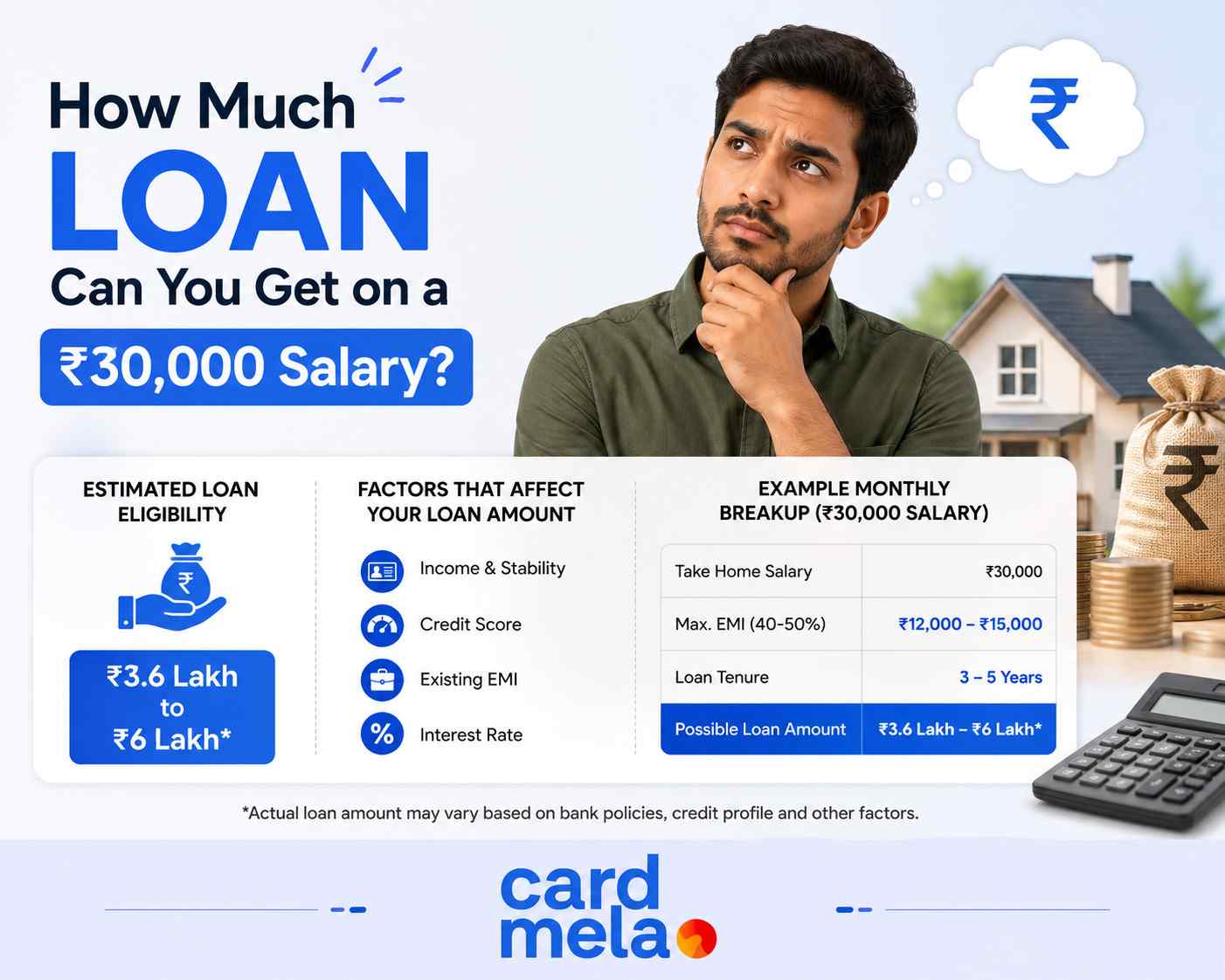
Most lenders prefer that total EMI obligations remain between 40% and 50% of monthly income. For someone earning ₹30,000 per month, this generally means total EMI commitments should ideally stay below ₹12,000 to ₹15,000 per month. This helps ensure that borrowers can comfortably manage household expenses while repaying the loan.
Banks also examine employment stability. Applicants working with reputed organizations and having consistent employment records are generally viewed as lower-risk borrowers. Similarly, a strong credit score demonstrates financial discipline and significantly improves approval chances.
Table: Estimated Loan Eligibility on ₹30,000 Monthly Salary
| Loan Type | Approximate Eligibility |
|---|---|
| Personal Loan | ₹2 Lakh – ₹8 Lakh |
| Home Loan | ₹12 Lakh – ₹25 Lakh |
| Car Loan | ₹3 Lakh – ₹10 Lakh |
| Two-Wheeler Loan | ₹50,000 – ₹2 Lakh |
| Education Loan | Depends on co-applicant |
| Consumer Durable Loan | ₹20,000 – ₹3 Lakh |
Why Your Credit Score Matters More Than Salary
A surprising reality in modern banking is that a strong credit score can sometimes influence approval decisions more than salary alone. Financial institutions want evidence that borrowers can manage debt responsibly. This evidence comes from credit reports.
A borrower with a score above 750 often receives:
- Faster approvals
- Higher loan amounts
- Lower interest rates
- Better repayment terms
- Increased lender confidence
This is why responsible credit card usage can become a powerful tool for improving future loan eligibility.
Best Credit Cards to Improve Loan Eligibility and Financial Profile
Many people do not realize that the easiest way to improve future loan eligibility is by using a credit card responsibly. Banks and NBFCs closely examine repayment behavior before approving loans. A well-maintained credit card demonstrates financial discipline and helps build a positive credit history.
IDFC FIRST Wealth Credit Card
The IDFC FIRST Wealth Credit Card combines premium benefits with long-term financial value. Cardholders can build a stronger credit profile through regular spending and disciplined repayments. Since lenders evaluate credit history extensively during loan approvals, maintaining a positive record with this card can support higher borrowing capacity in the future.
AU Zenith+ Credit Card
The AU Zenith+ Credit Card targets professionals who seek premium rewards and financial flexibility. Although rewards are attractive, the true long-term advantage comes from establishing a healthy repayment track record. Consistent payment behavior can improve credit scores and strengthen eligibility for larger loans such as home loans and vehicle loans.
Standard Chartered Ultimate Credit Card
The Standard Chartered Ultimate Credit Card is suitable for consumers who regularly spend on travel, lifestyle, and premium services. Proper management of this card can contribute positively to credit history, which remains one of the most important factors influencing loan approvals in today’s banking environment.
SBI Pulse Credit Card
The SBI Pulse Credit Card is an excellent choice for salaried professionals looking to build a healthy credit profile. Regular usage combined with timely bill payments demonstrates responsible borrowing behavior and helps strengthen credit history. The card also offers wellness benefits, reward points, and lifestyle privileges, making it attractive for individuals seeking both financial growth and practical rewards. Over time, maintaining this card responsibly can improve the likelihood of personal loan, car loan, and home loan approvals.
HDFC Bank MoneyBack+ Credit Card
The HDFC MoneyBack+ Credit Card is popular among first-time credit card users because it combines simplicity with useful rewards. Consistent repayments and controlled spending can help users establish a positive credit history. Since many lenders closely examine repayment patterns during loan evaluations, maintaining a healthy record with this card can improve future borrowing opportunities significantly.
Axis Bank Neo Credit Card
The Axis Neo Credit Card is particularly suitable for young professionals beginning their credit journey. It offers benefits across online spending categories while helping cardholders develop responsible credit habits. By maintaining low credit utilization and paying dues on time, users can gradually strengthen their credit profile and improve their eligibility for larger loans.
Personal Loan Eligibility on ₹30,000 Salary
Among all loan products available in the market, personal loans are generally the most popular for salaried individuals earning ₹30,000 per month. Unlike home loans or car loans, personal loans do not require borrowers to pledge any asset as collateral. This makes them highly attractive for individuals seeking quick access to funds for emergencies, weddings, travel, education, medical expenses, or debt consolidation.
Most banks and NBFCs may offer personal loans ranging from ₹2 lakh to ₹8 lakh depending on the applicant’s credit score, employment profile, employer category, and existing financial obligations. However, it is important to remember that eligibility does not necessarily mean affordability. Borrowers should always evaluate whether the monthly EMI comfortably fits within their budget before accepting a loan offer.
A borrower earning ₹30,000 monthly and maintaining a strong credit score above 750 can often secure better interest rates and higher loan amounts compared to someone with a weaker credit history. Therefore, improving credit health before applying can significantly increase borrowing opportunities.
Home Loan Eligibility on ₹30,000 Salary
Owning a home remains one of the biggest financial goals for many Indian families. While some people assume a ₹30,000 salary may not be sufficient for a home loan, the reality is more encouraging. Depending on loan tenure, interest rates, co-applicant income, and credit profile, many lenders may approve home loans ranging between ₹12 lakh and ₹25 lakh.
Home loan eligibility is generally higher because repayment tenures can extend up to 20 or even 30 years. Longer repayment periods reduce monthly EMI burdens and allow borrowers to qualify for larger loan amounts.
Adding a spouse or family member as a co-applicant can further improve eligibility because lenders consider combined household income during assessment. This approach is commonly used by young families seeking larger home loan approvals.
Table: Estimated Home Loan Eligibility
| Monthly Salary | Approximate Home Loan Eligibility |
|---|---|
| ₹25,000 | ₹10 Lakh – ₹20 Lakh |
| ₹30,000 | ₹12 Lakh – ₹25 Lakh |
| ₹40,000 | ₹18 Lakh – ₹35 Lakh |
| ₹50,000 | ₹25 Lakh – ₹45 Lakh |
| ₹75,000 | ₹40 Lakh – ₹70 Lakh |
Can You Get a Car Loan on ₹30,000 Salary?
A monthly income of ₹30,000 is often sufficient to qualify for a car loan, especially when purchasing entry-level or mid-range vehicles. Most lenders finance between 80% and 95% of the vehicle’s on-road price, reducing the need for large upfront payments.
Car loan approvals depend on:
- Monthly salary
- Credit score
- Existing EMIs
- Down payment amount
- Employment stability
- Vehicle cost
A larger down payment can significantly improve approval chances while reducing EMI obligations. This also lowers total interest costs over the loan tenure.
For individuals earning ₹30,000 monthly, car loan eligibility generally falls between ₹3 lakh and ₹10 lakh depending on the overall financial profile.
Why Existing EMIs Can Reduce Loan Eligibility
One of the biggest mistakes borrowers make is assuming that salary alone determines loan eligibility. Existing financial obligations play an equally important role.
For example, consider two applicants earning ₹30,000 per month:
Applicant A has no EMIs.
Applicant B already pays:
- Personal Loan EMI: ₹5,000
- Bike Loan EMI: ₹3,000
Even though both individuals earn the same salary, Applicant A will generally qualify for a significantly larger loan because more disposable income is available for future repayments.
Banks use debt-to-income ratios to ensure borrowers are not overburdened with excessive debt.
Table: Impact of Existing EMIs
| Monthly Salary | Existing EMI | Loan Eligibility Impact |
|---|---|---|
| ₹30,000 | ₹0 | Maximum Eligibility |
| ₹30,000 | ₹3,000 | Slight Reduction |
| ₹30,000 | ₹6,000 | Moderate Reduction |
| ₹30,000 | ₹10,000 | Significant Reduction |
| ₹30,000 | ₹15,000 | Limited Eligibility |
How AI Is Changing Loan Approvals
Modern lenders increasingly use Artificial Intelligence (AI) and machine learning systems to evaluate loan applications. These technologies analyze thousands of data points within seconds to assess borrower risk.
AI systems evaluate:
- Income stability
- Credit history
- Spending patterns
- Banking transactions
- Repayment behavior
- Employment records
- Existing debt obligations
This allows lenders to process applications faster while reducing manual intervention. In many cases, digital loan approvals can now occur within minutes.
However, AI-driven lending also means that financial discipline has become more important than ever. Every payment, transaction, and repayment behavior contributes to your financial profile.
Benefits of Taking a Loan Responsibly
A well-managed loan can create opportunities that may otherwise take years to achieve through savings alone.
Responsible borrowing can help individuals:
- Purchase a home
- Buy a vehicle
- Fund education
- Handle emergencies
- Consolidate debt
- Improve financial flexibility
- Build credit history
The key difference between productive debt and harmful debt lies in repayment discipline and borrowing purpose.
When loans are used strategically and repaid on time, they can become valuable financial tools rather than financial burdens.
Common Reasons Loan Applications Get Rejected
Many applicants are surprised when lenders reject their applications despite having stable incomes.
Common rejection reasons include:
- Low credit score
- High debt burden
- Frequent loan applications
- Unstable employment history
- Documentation issues
- Poor repayment records
- Credit card defaults
- High credit utilization
Most of these issues can be corrected with proper financial planning before submitting a new application.
Table: Common Loan Rejection Reasons
| Reason | Impact |
|---|---|
| Credit Score Below 650 | High |
| Multiple Existing Loans | High |
| Frequent Loan Applications | Moderate |
| Job Instability | High |
| Missed EMI Payments | Very High |
| Credit Card Defaults | Very High |
| Incomplete Documents | Moderate |
| Income Verification Issues | High |
Why Building Credit Early Is Important
Many young professionals ignore credit building until they need a major loan. This often becomes a problem because lenders prefer applicants with established credit histories.
Using a credit card responsibly is one of the simplest ways to build a strong financial profile.
Benefits of responsible credit card usage include:
- Improved credit score
- Better loan eligibility
- Faster approvals
- Lower interest rates
- Stronger lender confidence
A credit card should not be viewed as extra income. Instead, it should be treated as a financial tool that helps establish credibility with future lenders.
Smart Financial Habits Before Applying for a Loan
Borrowers can significantly improve their approval chances by adopting a few simple financial habits before applying.
These include:
- Paying all EMIs on time
- Keeping credit utilization below 30%
- Avoiding unnecessary debt
- Maintaining stable employment
- Building emergency savings
- Monitoring credit reports regularly
- Comparing multiple lenders
These habits not only improve approval chances but also contribute to long-term financial stability.
Personal Loan vs Credit Card Loan
Many consumers earning ₹30,000 per month often wonder whether they should take a personal loan or use a credit card loan facility. While both options provide access to funds, they serve different purposes and come with different costs.
Personal loans generally offer larger loan amounts and longer repayment periods. Credit card loans, on the other hand, may provide faster approvals but often carry higher interest rates depending on the lender and repayment structure.
Table: Personal Loan vs Credit Card Loan
| Feature | Personal Loan | Credit Card Loan |
|---|---|---|
| Loan Amount | Higher | Lower |
| Interest Rate | Usually Lower | Often Higher |
| Approval Process | Standard | Faster |
| Repayment Tenure | Longer | Shorter |
| Documentation | Moderate | Minimal |
| Best For | Major Expenses | Short-Term Needs |
Advanced Tips to Increase Loan Approval Chances
Many applicants focus only on income while ignoring other factors that can dramatically improve loan eligibility. Before applying, borrowers should work on strengthening their overall financial profile. Maintaining a high credit score, reducing existing debt, and avoiding multiple loan applications within a short period can significantly increase approval chances.
Keeping credit card utilization below 30% is another important strategy. Lenders often interpret high utilization as a sign of financial stress. Similarly, maintaining stable employment with a reputable organization helps reassure lenders that future repayments are likely to remain consistent.
Borrowers should also avoid closing old credit cards unnecessarily. Older credit accounts contribute positively to credit history length, which is an important factor in credit scoring models.
Table: Financial Habits That Improve Loan Eligibility
| Habit | Positive Impact |
|---|---|
| Timely EMI Payments | Very High |
| High Credit Score | Very High |
| Low Credit Utilization | High |
| Stable Employment | High |
| Low Existing Debt | High |
| Long Credit History | Medium |
| Regular Savings | Medium |
| Limited Loan Applications | Medium |
Why Loan Affordability Matters More Than Eligibility
One of the biggest financial mistakes consumers make is borrowing the maximum amount approved by the lender. Eligibility simply means a bank is willing to lend a certain amount. It does not necessarily mean the borrower should accept the entire amount.
A loan should support financial goals without creating unnecessary stress. Borrowers should carefully evaluate monthly expenses, future financial commitments, emergency savings, and long-term goals before finalizing loan amounts. Choosing a smaller loan with a comfortable EMI often leads to greater financial stability than stretching finances to borrow the maximum available amount.
Internal Linking
- How to Build a Strong Credit Score by Swiping Your Credit Card
- Personal Loan vs Credit Card Loan: Which Is Better?
- How Debt Settlement Affects Your Credit Score
- What Is a Credit Card Reissue?
- UPI Credit Cards Becoming India’s Next Big Payment Trend
- Why Banks Want More Customers Using Digital Payments
- Best Cashback Credit Cards for Salaried Employees
- Hidden Credit Card Charges Most Users Ignore
- Money Habits That Separate Rich & Middle-Class Families
External Linking
- Reserve Bank of India (RBI)
- TransUnion CIBIL
- Experian India
- CRIF High Mark
- Equifax India
- National Payments Corporation of India (NPCI)
- HDFC Bank Loans
- Axis Bank Loans
- State Bank of India Loans
- BankBazaar Loan Calculator
Conclusion
A monthly salary of ₹30,000 can open the door to a wide variety of borrowing opportunities, including personal loans, car loans, education loans, consumer durable financing, and even home loans under the right circumstances. However, income alone does not determine how much money a lender is willing to provide. Modern banks evaluate the complete financial profile of an applicant, including credit score, repayment history, employment stability, debt obligations, and overall financial behavior.
For individuals seeking larger loan amounts, improving credit health should become a priority. Responsible credit card usage, timely bill payments, low credit utilization, and consistent financial discipline can significantly strengthen borrowing capacity over time. Rather than focusing solely on maximum eligibility, consumers should prioritize affordability and long-term financial sustainability.
The smartest borrowers understand that loans are financial tools, not financial solutions. When used responsibly, loans can accelerate personal and financial growth. When mismanaged, they can create unnecessary stress and debt burdens. By maintaining a healthy credit profile and borrowing within reasonable limits, salaried individuals can achieve important life goals while preserving long-term financial stability.
FAQs (Frequently Asked Questions )
How much personal loan can I realistically get on a ₹30,000 monthly salary?
Most lenders may offer a personal loan ranging between ₹2 lakh and ₹8 lakh depending on factors such as credit score, employment profile, existing EMIs, repayment history, and lender-specific policies. Applicants with stronger financial profiles generally qualify for higher loan amounts and better interest rates.
Can I get a home loan while earning ₹30,000 per month?
Yes. Many banks offer home loans to individuals earning ₹30,000 monthly. Depending on loan tenure, credit score, co-applicant income, and debt obligations, eligibility may range between ₹12 lakh and ₹25 lakh or even higher in some cases.
What credit score should I maintain before applying for a loan?
A credit score above 750 is generally considered strong by most lenders. Higher scores improve approval chances and may help secure lower interest rates. Consistent repayment behavior and responsible credit card usage are among the best ways to maintain a healthy score.
Do existing EMIs reduce loan eligibility?
Yes. Existing EMIs directly affect your debt-to-income ratio, which lenders use to determine affordability. Higher monthly obligations leave less disposable income available for future loan repayments and may reduce eligibility.
Can a credit card improve my chances of getting a loan?
Absolutely. Responsible credit card usage helps establish credit history and demonstrates repayment discipline. Over time, this can improve credit scores and strengthen future loan applications.
Is it possible to get a loan with a low credit score?
While some lenders may approve loans for applicants with lower credit scores, approval chances are generally lower and interest rates may be higher. Improving credit health before applying often leads to better outcomes.
Which loan is easiest to get on a ₹30,000 salary?
Personal loans are often the easiest because they typically do not require collateral. However, approval still depends on factors such as creditworthiness, income stability, and repayment capacity.
Why do banks reject loan applications even when salary requirements are met?
Loan rejections often occur because of poor credit scores, high existing debt, frequent loan applications, unstable employment history, incomplete documentation, or repayment concerns identified during underwriting.
Should I accept the maximum loan amount offered by a lender?
Not necessarily. Borrowers should evaluate affordability carefully and select a loan amount that fits comfortably within their budget. Taking excessive debt can create unnecessary financial pressure.
What is the smartest way to increase loan eligibility?
The most effective strategy is to improve credit score, reduce existing debt, maintain stable employment, pay all bills on time, and build a positive financial history before applying.
Author Bio
CardMela is a leading personal finance and credit card platform dedicated to helping Indian consumers make smarter financial decisions. Through in-depth analysis of credit cards, loans, banking products, UPI innovations, digital payments, and consumer finance trends, CardMela simplifies complex
Whether you’re looking for cashback, travel rewards, fuel savings, or lifetime free cards — CardMela helps you compare, analyze, and choose the credit card that fits your lifestyle perfectly. We partner with leading partners to bring you exclusive offers and detailed insights, so you can make smart financial decisions with confidence.
© 2025 CardMela.com. All rights reserved.
